
Ever wondered why some people burn after five minutes in the sun while others develop a golden tan effortlessly? The answer lies in your Fitzpatrick skin type which is a scientific scale developed by Harvard dermatologist Thomas B. Fitzpatrick in 1975 that classifies skin based on its pigmentation and response to UV exposure. Knowing your type isn’t just interesting, it’s genuinely useful for everything from choosing the right SPF to understanding whether at-home laser hair removal will work for you.
What Is the Fitzpatrick Scale?
The Fitzpatrick scale divides skin into six types (I – VI) based on two factors: how much melanin your skin naturally contains, and how it reacts to sun exposure. It was originally developed as a medical tool to help dermatologists assess skin cancer risk, but today it’s widely used in aesthetics and beauty technology to determine who is a suitable candidate for treatments like laser hair removal, chemical peels, and certain light-based therapies.
Note: It’s also one of the most useful things to know before investing in any at-home beauty device, more on that below.
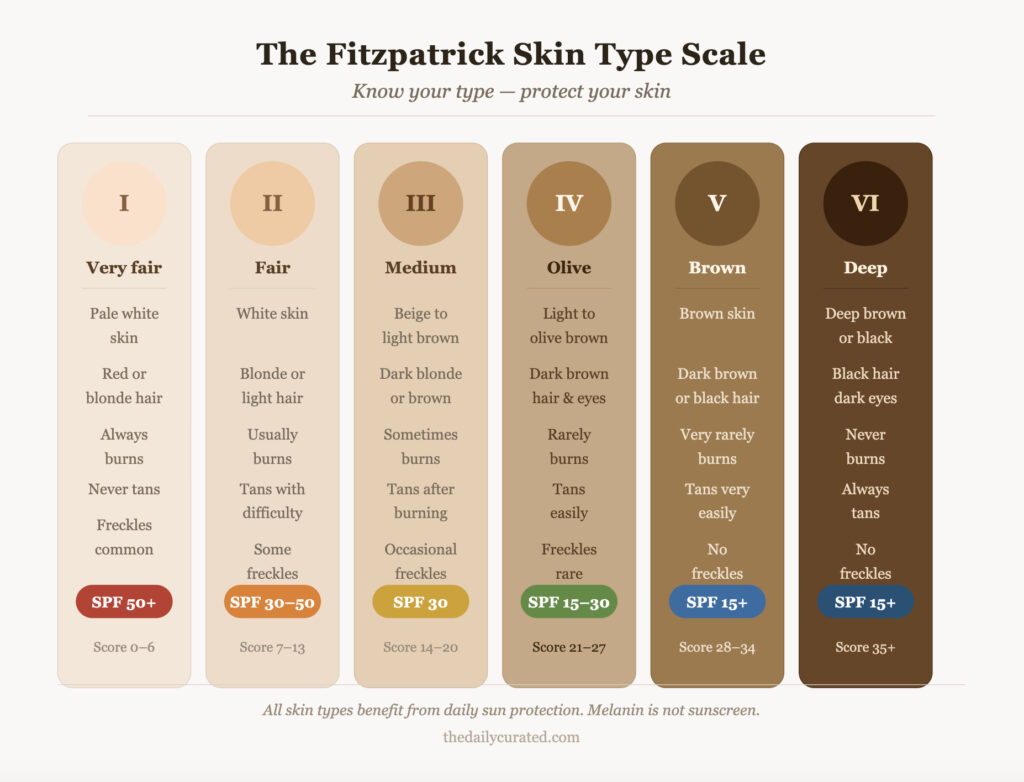
Find Your Fitzpatrick Skin Type
Answer each question and note your score, then add them up at the end.
Eye color
0 – Light blue, grey or green
1 – Blue, grey or green
2 – Blue
3 – Dark brown
4 – Brownish black
Natural hair color
0 – Sandy red
1 – Blonde
2 – Chestnut / Dark blonde
3 – Dark brown
4 – Black
Skin color on unexposed areas (e.g. inner arm)
0 – Reddish
1 – Very pale
2 – Pale with a beige tint
3 – Light brown
4 – Dark brown
Freckles on unexposed skin
0 – Many
1 – Several
2 – Few
3 – Incidental
4 – None
What happens if you stay too long in the sun?
0 – Painful redness, blistering, peeling
1 – Blistering followed by peeling
2 – Burns sometimes followed by peeling
3 – Rarely burns
4 – Never burns
How easily do you tan?
0 – Hardly or not at all
1 – Light tan after repeated exposure
2 – Tan gradually and moderately
3 – Tan easily and quickly
4 – Turn dark brown very quickly
Your score
0–6 → Type I
7–13 → Type II
14–20 → Type III
21–27 → Type IV
28–34 → Type V
35+ → Type VI
What Does Your Score Mean?
Type I — Very fair
Pale white skin, often with red or blonde hair and blue or green eyes. Always burns, never tans, frequently freckled. Highest risk of sun damage and skin cancer, daily SPF 50 is non-negotiable.
Type II — Fair
White skin, blonde to light brown hair, blue or green eyes. Usually burns, tans minimally and with difficulty. Still high sun sensitivity, SPF 30–50 recommended daily.
Type III — Medium
White to light beige skin, dark blonde or brown hair, any eye colour. Sometimes burns, gradually develops a light tan. Moderate sun sensitivity, SPF 30 daily.
Type IV — Olive
Light brown or olive skin, dark brown hair and eyes. Rarely burns, tans easily. Lower sun sensitivity but sun protection is still important, SPF 15–30 daily.
Type V — Brown
Brown skin, dark brown to black hair, dark eyes. Very rarely burns, tans very easily. SPF 15 minimum, skin cancer risk is lower but not zero.
Type VI — Deep
Deeply pigmented dark brown or black skin, black hair, dark eyes. Almost never burns, always tans. Daily SPF is still recommended, melanoma in darker skin tones is rarer but often diagnosed later and more seriously.
Important: Regardless of your skin type, all dermatologists agree that daily sun protection benefits everyone. Melanin offers some natural protection, but it is not sunscreen.
Why Your Fitzpatrick Type Matters for Laser Hair Removal
This is where knowing your skin type becomes really practical. Laser and IPL hair removal devices work by targeting melanin in the hair follicle, the darker the hair against the skin, the more effective the treatment. However, if your skin itself is very dark, the device can struggle to distinguish between melanin in the skin and melanin in the hair, which can cause irritation or uneven results.
Types I–III — typically excellent candidates for at-home laser devices, especially with dark hair.
Types IV–V — can see good results with newer technology designed for broader skin tone ranges; always check the device specifications.
Very light hair (blonde, red, grey) on any skin type — laser is less effective since there is minimal melanin in the follicle to target.
If you’ve been considering at-home laser hair removal, knowing your Fitzpatrick type first is the smartest first step — read our full ViQure S-LD review here.
Fitzpatrick Type and Your Skincare Routine
Beyond laser treatments, your skin type is a useful guide for everyday skincare decisions.
Retinol and acids — Types I and II tend to be more reactive, so starting with lower concentrations and building up slowly is wise. Types IV–VI can generally tolerate stronger formulations.
Hyperpigmentation — More common in Types IV–VI because melanin-rich skin produces more pigment in response to inflammation, sun exposure, or hormonal changes. Look for brightening ingredients like vitamin C, niacinamide, and azelaic acid.
Skin cancer checks — Types I and II should see a dermatologist annually from around age 30. Types III and IV from around age 40. Types V and VI are at lower risk but should still get checked regularly, skin cancer in darker tones is often caught later.
The Bottom Line
Knowing your Fitzpatrick skin type takes about two minutes and gives you information you’ll use for the rest of your life, from choosing the right SPF to understanding which beauty devices will actually work for you. If your quiz result suggests you’re a good candidate for at-home laser hair removal, our ViQure S-LD review is a great next read. And if sun protection is something you’ve been putting off, consider this your sign to find a formula you actually enjoy wearing daily.
Leave a Reply